
By Nicholas Karter, MD — Double board-certified facial plastic surgeon, Karter Advanced Facial Plastic Surgery, Glastonbury, CT Medically reviewed by the author. Last updated October 6, 2026.
The choice comes down to whether you have true under-eye bags or just volume loss. If you have a genuine lower eyelid bag, only a lower blepharoplasty can correct it. Filler can disguise a bag but can’t remove it. If you have a hollow tear trough area without a bag, tear trough filler or isolated fat grafting are both reasonable options. Each comes with a different tradeoff between predictability and longevity.
The 3 Age-Related Changes Around the Eyes
When I evaluate the under-eye area, I’m really looking at three distinct changes. However, they don’t all call for the same treatment.
1. Lower eyelid bags. These are the areas of protrusion directly under the lower eyelid skin. When we look at the lower lids, there is skin. Under the skin is a thin layer of muscle, and then, under that muscle is the orbital septum. The orbital septum is essentially a fibrous band that holds back the fat pads that surround the eyeballs. Partly genetically (you’ll see bags run in families) and partly with time, this fibrous band starts to weaken. As it loosens, the fat pads behind it push forward, and that’s what creates the visible bag.
2. The tear trough. This is a separate issue entirely, and it is caused by volume loss directly beneath the eyes. As the cheek fat pad sinks and loses volume over time, the bony rim of the eye socket becomes more exposed, which is what creates the hollow, shadowed area known as the tear trough.
3. Skin quality changes. The lower lid skin itself becomes less elastic, can develop pigmentation irregularities, and tends to show fine, crepe-paper-like wrinkling. Unlike upper eyelid skin, lower lid skin generally doesn’t become redundant or have excess, but rather it just loses its quality.
Knowing which combination of these three is actually driving your under-eye appearance is what determines the right treatment.
If You Have a True Bag: Lower Blepharoplasty Is the Only Real Fix
If a genuine lower eyelid bag is present, the gold-standard treatment is a lower blepharoplasty. A lower blepharoplasty is a surgery that removes or repositions the orbital fat pushing out against the lower lid. There are two main surgical approaches: one through the skin (transcutaneous) and one through the inside of the eyelid (transconjunctival). I almost exclusively use the transconjunctival approach, since it hides the incision completely behind the eyelid. This approach also meaningfully reduces risk, especially of ectropion, a complication where the lower lid pulls away from the eye.
The single biggest key takeaway is this: if a true bag is present, nothing short of a lower blepharoplasty will actually reduce it. Tear trough filler can be used to hide a bag by filling in the hollow beneath it, but that’s masking the problem, not treating it. A lower blepharoplasty, by contrast, removes or repositions the actual fat causing the bag. It is the only way to truly treat the underlying cause.
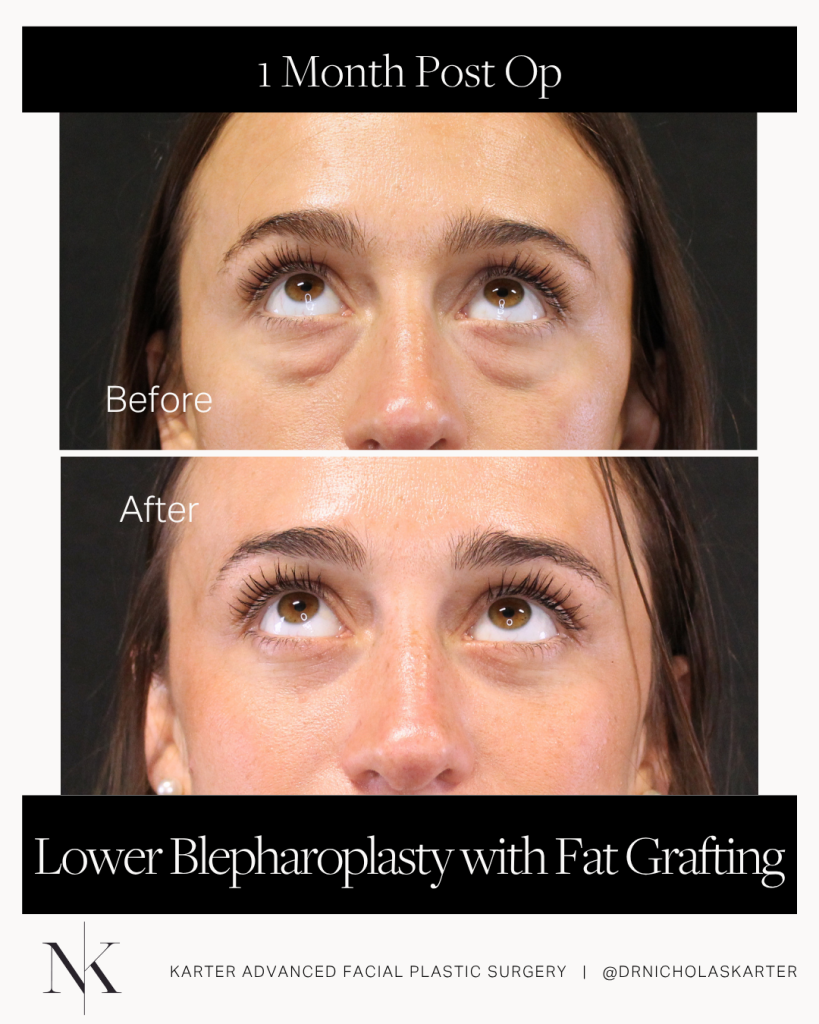
Fat Grafting vs. Tear Trough Filler: Two Ways to Restore Volume
When there’s a tear trough present alongside a bag, I perform fat grafting to the tear trough at the same time as the lower blepharoplasty. Both fat grafting and tear trough filler aim to do the same thing; to restore lost volume to the tear trough area. However, they work in very different ways, with different tradeoffs.
Fat Grafting
Fat grafting uses your own fat, harvested via micro liposuction cannulas from the lower abdomen or outer thighs, specially processed, and reinjected into the tear trough area. Because it’s your own tissue, a successful graft is extremely long-lasting.
The tradeoff is predictability. The “take rate” (how much of the grafted fat survives long-term) varies significantly by patient. In roughly 20% of cases, the body reabsorbs the fat entirely. In the remaining 80%, some amount survives, but that amount ranges anywhere from a small fraction up to the full graft, and there’s no reliable way to predict in advance who falls where.
My approach is to graft what I estimate will be a full, 100% result and stop there. I do not intentionally overfill expecting loss, because if you’re the patient that retains the full graft, an overfilled area is very difficult to correct afterward.
Tear Trough Filler
Tear trough filler, almost always a hyaluronic acid–based product, restores volume in the same way but with an external, injectable material instead of your own tissue. The main advantage is predictability. You don’t run the risk of losing all the correction the way you can with fat grafting, since it doesn’t depend on your body accepting a graft.
The tradeoffs are different, not necessarily smaller. Hyaluronic acid filler is processed through the face’s lymphatic channels. These are essentially the drainage pathways that move fluid from your head back toward your central circulation. As hyaluronic acid filler enters those channels, it can partially obstruct them, causing fluid to back up behind it. That backup, not the filler itself, is often what causes the puffy, waterlogged look some people associate with under-eye filler. Filler can also migrate from its original position over time. If it moves too close to the skin’s surface, its natural tendency to hold onto water can create a bumpy, watery appearance. Reactions to the filler itself are also possible, though less common than these tissue-level effects.
So Which Should You Choose?
If you have both a lower eyelid bag and a tear trough, and you want to correct the underlying anatomy, not just mask it, a lower blepharoplasty with fat grafting is the more complete, natural, and long-lasting solution.
If you don’t have a bag and the tear trough is your only concern, isolated tear trough volumization is reasonable, and the choice between fat grafting and filler comes down to what you value more: fat grafting’s longevity versus its unpredictability, or filler’s predictability versus its risk of migration and fluid-related puffiness over time.
In my practice, most patients evaluated for under-eye concerns end up being good candidates for a lower blepharoplasty with fat grafting. But isolated tear trough treatment can absolutely be the right call when there’s no bag present. The right choice is really down to your anatomy and what is bugging you.
Lower Blepharoplasty & Tear Trough FAQ
Can tear trough filler fix under-eye bags? No. Filler can disguise a bag by filling the hollow beneath it, but it doesn’t remove or reposition the fat causing the bag. Only a lower blepharoplasty treats the actual cause.
What’s the difference between fat grafting and tear trough filler? Both restore volume to the tear trough, but fat grafting uses your own fat and is very long-lasting with a variable, unpredictable take rate. Hyaluronic acid filler is more predictable upfront but can migrate or cause fluid buildup in the surrounding tissue over time.
Why do some people get puffy or watery-looking after tear trough filler? This is often caused by filler placement too close to the skin’s surface or migration towards the skin’s surface. It can also be caused by the filler partially obstructing the face’s lymphatic drainage channels, leading to fluid backing up in the surrounding tissue, rather than the filler volume itself.
Do I need a lower blepharoplasty, or is filler enough? It depends on whether you have a true lower eyelid bag. If you do, a lower blepharoplasty is the only way to correct it. If your only concern is a hollow tear trough with no bag, filler or isolated fat grafting are both reasonable options.
What surgical approach is used for a lower blepharoplasty? There are two approaches, through the skin (transcutaneous), or through the inside of the eyelid (transconjunctival). The transconjunctival approach, which is my preferred approach, hides the incision entirely and carries a lower risk of ectropion.
Considering Treatment for Under-Eye Bags or Hollowing?
Dr. Nicholas Karter is a double board-certified facial plastic surgeon serving Glastonbury, Hartford, Wethersfield, Avon, and Farmington, CT, specializing in lower blepharoplasty with fat grafting. Request a consultation to determine which approach fits your anatomy, or learn more about Lower Blepharoplasty at Karter Advanced Facial Plastic Surgery.
Leave a Reply